Showing posts with label Danish Army. Show all posts

Wednesday, July 9, 2025

Blenheim, Order of Battle, part II: the Imperial Army


Since V&B is a roster-based system I opted to put here directly the roster I prepared for the scenario, beginning with the Prince Eugene Imperial Army. 

In V&B terms these are 19 SP of Infantry, equivalent to 9500 soldiers, 18 SP of Cavalry, equivalent to 9000 horses and 2 SP of Artillery, equivalent to 12 Field pieces: by taking into account the 24 battalion guns of the Prussian brigades we arrive at a total of 18500 rank and file (against the 17924 present at the battle) and 36 guns (against the 37 recorded in the various OoB).


The Army Commander, Field-Marshal Prinz Eugen von Savoy:


here with the two Imperial field batteries:
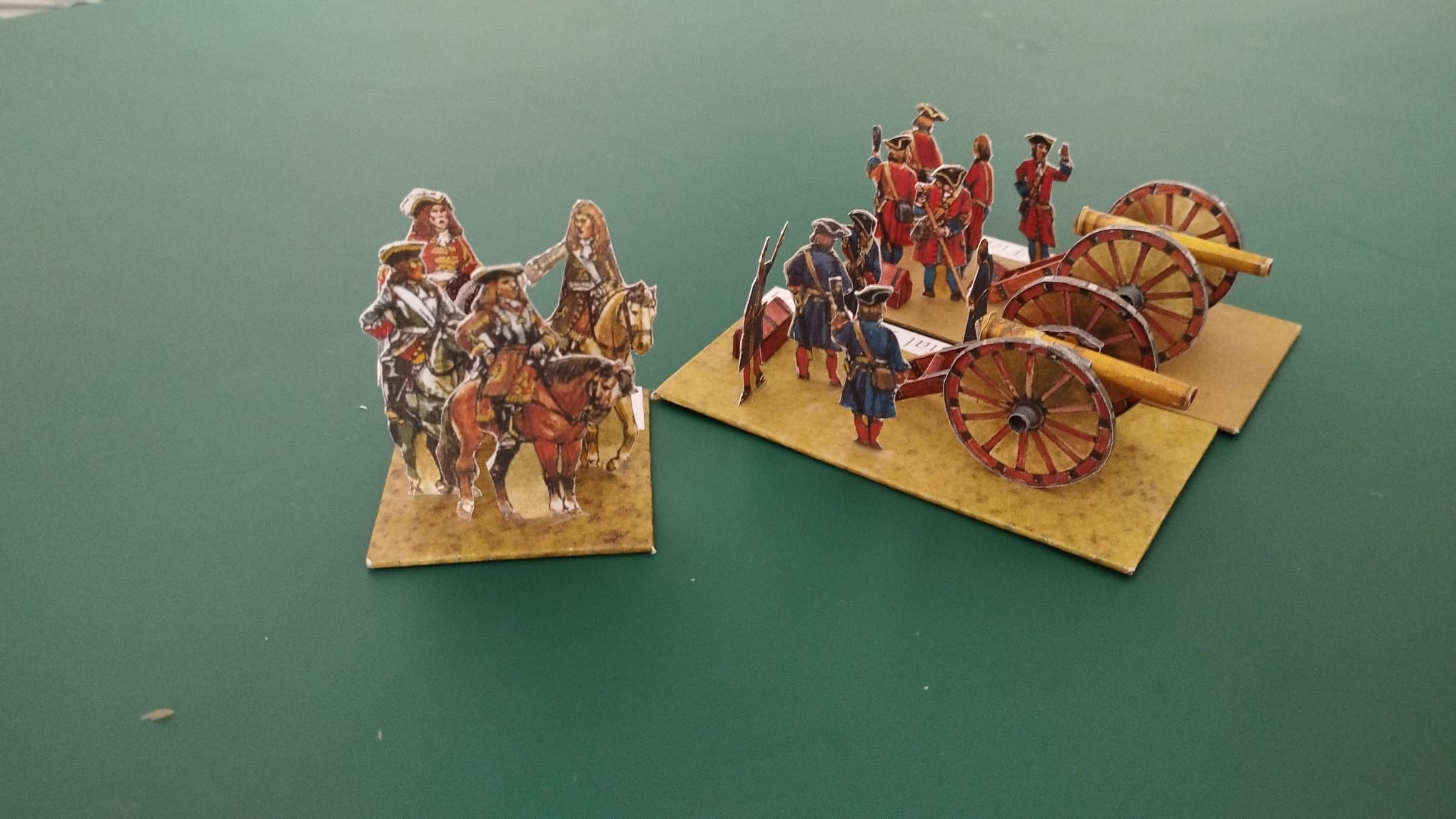


The Infantry Corps is commanded by the Graf Leopold von Anhalt-Dessau:


It is formed by two divisions: the Prussian division is commanded directly by Anhalt-Dessau: at the left the Fink brigade, at the right the Canitz brigade, both on two bases. Since in the OoB each brigade was formed by battalions from different regiments, I decided to represent a single regiment for each base, choosing the one for which the most details about flags and uniforms are known. The Finck brigade bases accordingly represents the Anhalt-Dessau and Kronprinzen regiments, whereas the Canitz brigade bases represent the Canitz and Leib regiments.  I based my research mainly on the Robert Hall CD and on the articles provided by Kronoskaf together with other sources like the beautiful blog Not By Appointment, a veritable goldmine for lesser-known flags and uniforms.


The Danish division is commanded by the Lt. Gen. Scholten:


On the left the Bielke brigade (Livgardet and Prins Georg regiments) and on the right the Rebsdorff brigade (Sajellandske and Finske regiments).


The Cavalry Corps is commanded by the Prinz Maximilian von Hanover (Braunschweig-Luneburg, indeed):


The Prince also was in command of the first division which is on three brigades. This time for each brigade I chosed two representative regiments and therefore we have from left to right: brigade Natzmer (Prussian Wartensleben and Leibregiment), brigade Függer (Austrian Hanover and Lobkovitz Cuirassiers), brigade Baden-Durlach (Austrian Lymburg Dragoons and Swabian Függer Cuirassiers).


The second division is commanded by the Graf von Würtemberg-Teck 


and is on three brigades too: from the left L’Ostange (Prussian L’Ostange Cuirassiers and Sonsfeld Dragoons), Bibra (Palatine Venningen and Swabian Helmsdorf Cuirassiers), Cusani (Austrian Cusani and Darmstadt Cuirassiers).


The Reserve Cavalry division is represented by two brigades, since I fudged two brigades into one. It is commanded by the Prince De Latour-Valsassina (I didn't find a pictur, or better I was able to find many La Tour-Valsassina, but it seems that none of them was in active military service in 1704) and its brigades are Efferen/Caraffa (Holstein von der Osten Cuirassiers and Wurzburg Fechenbach Dragoons) and Bayreuth (Franconian Brandenburg-Bayreuth Cuirassiers and Auffess Dragoons).


a


Saturday, February 6, 2021

Blenheim: the refight, part I


The battle starts following the historical plans: Eugene and Cutts attacking on the wing, then Marlborough pushing at the center. 


Here the Imperial cavalry crossing the  Nebel to engage the Franco-Bavarians:


Cutts and the Palmer cavalry crossing the Nebel towards Blenheim:


The cavalry battle developed with a see-saw evolution which will last nearly to the end. At the first stages the Imperial are at disadvantage since they must stop to cross the Nebel being penalised in melee:


Eugene infantry moves to attack Oberglau (to make things easier I removed the village to arrange troops inside)


Lord Cutts has crossed the Nebel without any French reaction and closes on Blenheim. The French choose a defensive attitude, with Clereambault being careful to not be sucked into the battle for the village: at the end this will prove a costly error.


The cavalry battle still rages without a clear winner, to this moment


Clereambault unleashes the Maison du Roi on the flank of Cutts, with Palmer's cavalry closing in support


The situation becomes hot in Oberglau, the garrison commanded by Blainville puts up a stiff resistance and Eugene infantry must retire with losses to reorganise


Under Cutts pressure Blenheim falls, despite a spirited counterattack of Clereambault, which arrives too late to prevent the disaster.


On the Franco-Bavarian vs. Imperial side, the Confederate are slowly taking the edge:

This is the situation at the end of the 5th move: Tallard and Marlborough are still idle, waiting for the battles on the wings. Maybe Tallard should send reinforcements to his right.

To follow.

Wednesday, August 12, 2020

On the road again


A new post after a long time. I was unfortunately enough to be caught by the lockdown far from my house. So I didn’t  spent all my quarantine time painting minis or playing wargames and boardgames as many of you did.

Back home at the end of June I finally took brushes  again to complete the doubling of Danish cavalry: here you can see the result (yes, many bases are still unfinished because in the meantime I  also finished the Vallejo texture…). All the details about the regiments were given  in older posts.


Friday, September 20, 2019

Swedish temporary foot and Danish cuirassiers


To add some variety in my Swedish army I added two “temporary units” in gray coats.


The first one is the Smaland Tremannings. It was in Livland and then with the Lewenhaupt army. After the disaster at Lesnaja the survivors were placed in the Livgardet. According to Hoglund the coat was blue but the “gray vadmal pajrock” with yellow linings and cuffs was in use for the privates. The second regiment is the Södermalands (och Östgota) Tremannings (blue lining). It was a short lived unit, broken in 1703 after the Colonel Putbus death, one battalion transferred to Livgardet, the other to the Upplands Tremannings. Reraised in 1712 with an history of reraising and breaking till 1721. Miniatures are the usual mix of Strelets and Mars.

As it can be seen in previous post, the Danish cavalry for Helsinborg was painted with one base for each regiment. However, as I did for the Swedish and Russian cavalry all the regiments will be double-based. In this way two bases can be used as “regimental base” for V&B and a four-bases unit for Maurice will represents a two-regiment brigade.


The first regiment I put in full strenght is the 1st Jyske (Jutland) Cavalry Regiment in its “vintage” XVIIth century cuirassiers attire. The ensign has a converted hat from a tricorne into the old-fashioned one wich is depicted in the Snorranson article on the Danish Army, whereas the cuirassier in the other base had an head-swapping with another miniature.

Saturday, September 7, 2019

More GNW miniatures


End of holidays painting: the Busch Grenadier regiment, raised in 1708 from the grenadier companies of the Belozerski, Lefortski, Viatski, Kievski, Rentzel, Rostovski, Tobolski, Olonerski, Koporieski and Ivangorodski regiments, from 1715 Weide’s Regiment. Present at  Holowczin and Poltava, then at the Prut an from 1711-19 in Pomerania. The blue uniform was introduced in 1711. Three grenadiers are from Zvedza “Russian Infantry of Peter the Great” box, the other three are converted from the Preobrazenski grenadiers from the Strelets box “Guard of Peter I”, by modifying the grenadier cap.


The cavalry was from the Zvedza box “Dragoons of Peter I”: they are simply outstanding, areal pleasure to paint. The flag has the motif in relief but it was not a problem since it was exactly the motif of the Moskowsky regiment I opted to paint. The only drawbacks of the box is that it has only 10 figures on the horse, the other being dismounted dragoons (nicely done with the horse holders and different arms): this requires a disproportionate amount of boxes to obtain a sizeable force. However one can have also a sizeable force of dismounted dragoons. The Moskowsky regiment was raised in Moscow in 1700 as Gulitz’s (Goltz). At Narva, then in the baltic theatre, at Kalisz 1706, Poltava and Pruth. The officers wore the red waistcoat with blue cuffs, a nice variation.


To finish, a third artillery base for the Danish army, once again from the Strelets “Artillery of Charles XII”:


It is time to make the second base for all the Danish cavalry I did previously: then I shall have enough bases to replay Helsinborg with both Maurice and Volley&Bayonet. Stay tuned.

Tuesday, April 18, 2017

A small pause and new projects


After completing the Swedish for Poltava, a little pause before the next achievements. Next goal will be the completion of the Russian Army which is underway. Then I shall double all the Danish cavalry bases.

At this point  something of out-of-the-track could be done. I am already planning to do a couple of Tremannings regiments in gray coat and the Valacks, these by using the Orion cossacks. By the way the Valacks can be used either as Polish or Russian Cossacks, the only difference will be a “command base” with a swedish officier for Valacks, a Polish flag for the Poles and I don’t know what for the Russians.

Having done the Swedish, Russian and Danish armies (enough to refight Holowczin, Poltava and Helsinborg), it could be the time to move my attention to the Saxon-Polish army which can widen the horizon to Klissow, Fraustadt and Gadebusch as well as to a lot of smaller actions (the crossing of Duna in 1701 would be an interesting scenario, look here for an example)


The uniforms are well documented, at least for the Saxon part. Besides the Hoglund book there are the Dan Schorr tables from his defunct site Northernwars.com. For the Polish contingent some informations can be obtained by the two Osprey volumes of R. Brezinski on the Polish Army and from the blogs Oderint dum Probent and Kadrinazi. Anyway it will become necessary at least to have some Winged Hussards, a colorful addition to any collection. The other cavalry (Pancerni, Jadza Lekka, Dragoons and Arquebusier, Cossacks) and the elusive infantry units can follow later.
Since I had a very good experience with the Mars Saxon Infantry, which I used to represent the Danish, I’ll probably use them to depicts my Saxon Infantry. I have not yet decided if I’ll use the Zvedza or the Strelets miniatures for the cavalry. 

I would like also to finish the Kolin analysis, this time with V&B and DB-Hx (or HFG) and give a similar treatment to some GNW battles. 

Wednesday, November 9, 2016

Danish Infantry at Helsinborg. Part II


The last five regiments of Danish infantry are finally completed.

The Drottingens Regiment (a.k.a. The Queen Regiment), unique in its red coat which will become the standard uniform color after 1716. The grenadier is based on the drawing from the Snorrasson article, which actually represents a grenadier NCO:


the Fynske Regiment, with its unique red collars (but it seems that is an error and that probably it was a necklace: anyway I liked it….)


the Jyllandske (Jutland) Regiment: the grenadier cap is based on an illustration taken from Snorranson.


Two milita units, the Vestsajellandske and the Ostsajellandske Landsmilitia: the sources states that the Landsmilitia flag was the simple “Danneborg”, the white maltese cross on red field.


In the last picture the Danish army in its OoB at Helsinborg, 1710: