Wednesday, July 9, 2025

Blenheim, Order of Battle, part II: the Imperial Army


Since V&B is a roster-based system I opted to put here directly the roster I prepared for the scenario, beginning with the Prince Eugene Imperial Army. 

In V&B terms these are 19 SP of Infantry, equivalent to 9500 soldiers, 18 SP of Cavalry, equivalent to 9000 horses and 2 SP of Artillery, equivalent to 12 Field pieces: by taking into account the 24 battalion guns of the Prussian brigades we arrive at a total of 18500 rank and file (against the 17924 present at the battle) and 36 guns (against the 37 recorded in the various OoB).


The Army Commander, Field-Marshal Prinz Eugen von Savoy:


here with the two Imperial field batteries:
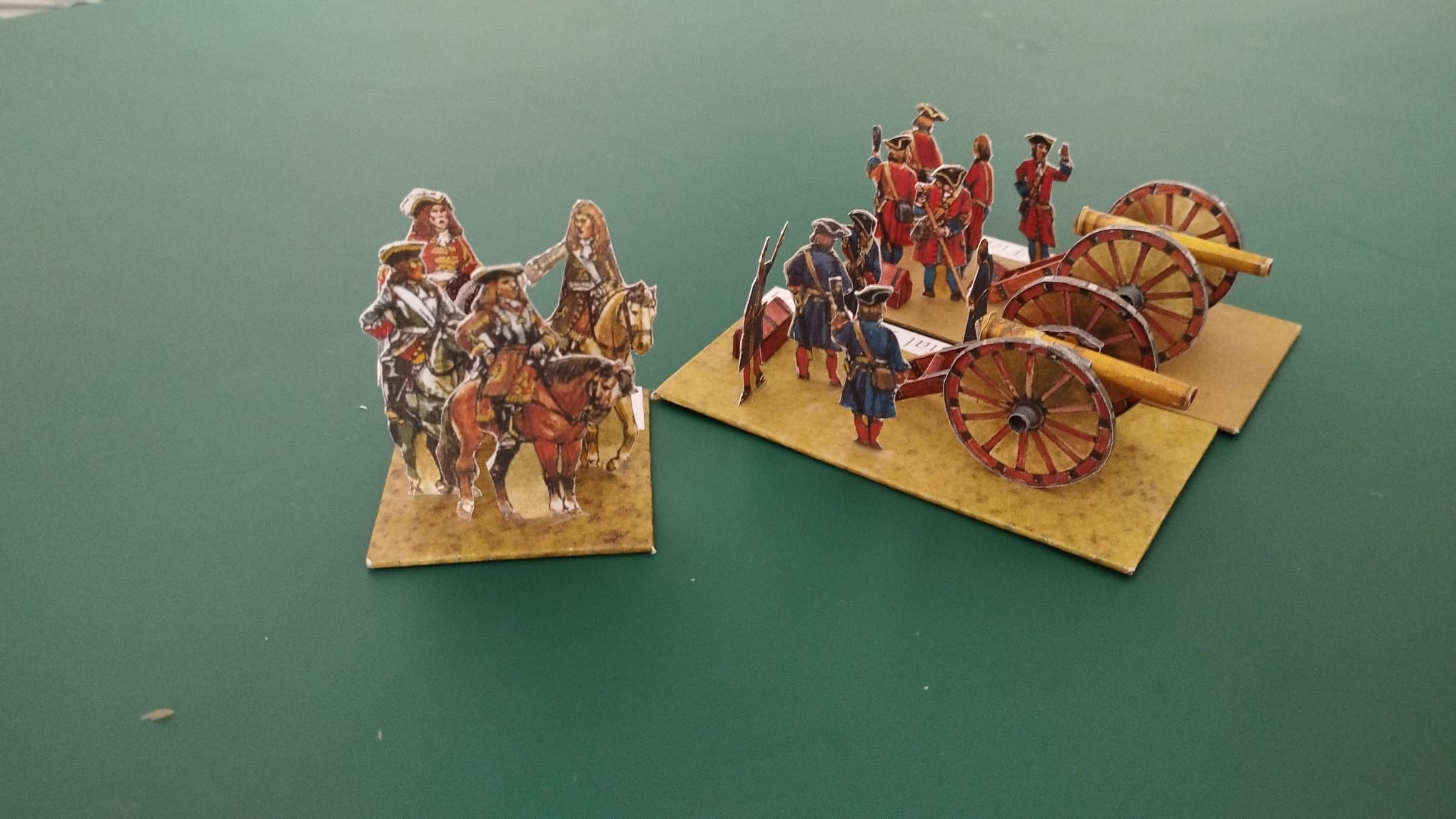


The Infantry Corps is commanded by the Graf Leopold von Anhalt-Dessau:


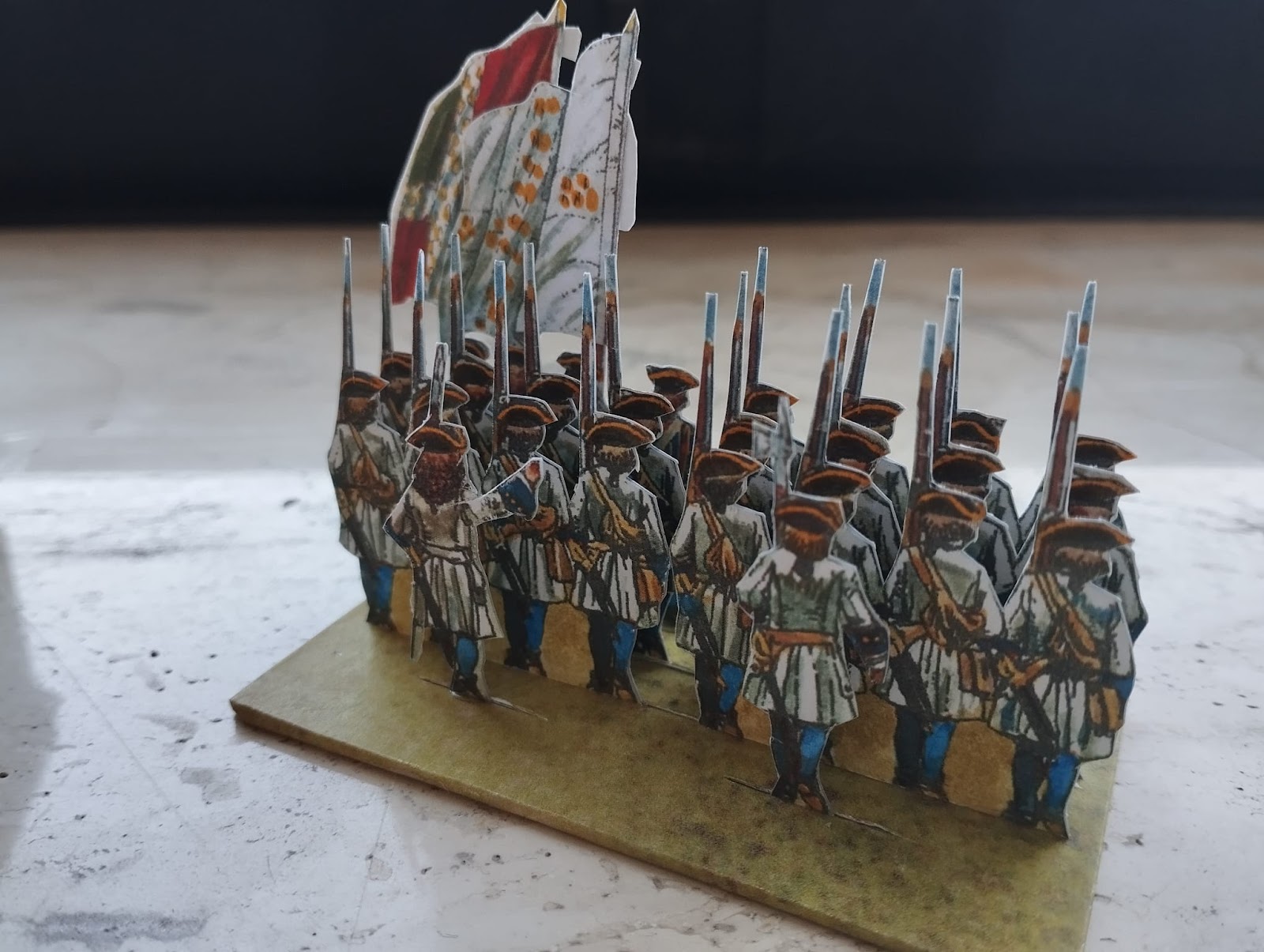
It is formed by two divisions: the Prussian division is commanded directly by Anhalt-Dessau: at the left the Fink brigade, at the right the Canitz brigade, both on two bases. Since in the OoB each brigade was formed by battalions from different regiments, I decided to represent a single regiment for each base, choosing the one for which the most details about flags and uniforms are known. The Finck brigade bases accordingly represents the Anhalt-Dessau and Kronprinzen regiments, whereas the Canitz brigade bases represent the Canitz and Leib regiments.  I based my research mainly on the Robert Hall CD and on the articles provided by Kronoskaf together with other sources like the beautiful blog Not By Appointment, a veritable goldmine for lesser-known flags and uniforms.


The Danish division is commanded by the Lt. Gen. Scholten:


On the left the Bielke brigade (Livgardet and Prins Georg regiments) and on the right the Rebsdorff brigade (Sajellandske and Finske regiments).


The Cavalry Corps is commanded by the Prinz Maximilian von Hanover (Braunschweig-Luneburg, indeed):


The Prince also was in command of the first division which is on three brigades. This time for each brigade I chosed two representative regiments and therefore we have from left to right: brigade Natzmer (Prussian Wartensleben and Leibregiment), brigade Függer (Austrian Hanover and Lobkovitz Cuirassiers), brigade Baden-Durlach (Austrian Lymburg Dragoons and Swabian Függer Cuirassiers).


The second division is commanded by the Graf von Würtemberg-Teck 


and is on three brigades too: from the left L’Ostange (Prussian L’Ostange Cuirassiers and Sonsfeld Dragoons), Bibra (Palatine Venningen and Swabian Helmsdorf Cuirassiers), Cusani (Austrian Cusani and Darmstadt Cuirassiers).


The Reserve Cavalry division is represented by two brigades, since I fudged two brigades into one. It is commanded by the Prince De Latour-Valsassina (I didn't find a pictur, or better I was able to find many La Tour-Valsassina, but it seems that none of them was in active military service in 1704) and its brigades are Efferen/Caraffa (Holstein von der Osten Cuirassiers and Wurzburg Fechenbach Dragoons) and Bayreuth (Franconian Brandenburg-Bayreuth Cuirassiers and Auffess Dragoons).


a


Sunday, July 6, 2025

Blenheim, Order of Battle, Part I


When I started with this project, the first thing was to obtain a goof OoB: in the case of Blenheim we have many detailed lists of the units as well as their strength. As far as the organization is concerned, for the Anglo-Allied army the various corps arrangement is clear; for the French-Bavarian there are some minor differences between the various orders.


In the flood of articles and books on the battle I stuck with the more recent sources, namely the Osprey Campaign 141 “Blenheim 1704 – The Duke of Marlborough’s masterpiece”, by John Tincey, the various Falkner’s books on the subject (one for all Blenheim 1704 – Battle Story) and the very detailed OoB provided into the article on the battle published into the blogspot Obscure Battles.

My first idea was to refight the battle with Volley and Bayonet: once more, there are many OoB for this rule, namely the one provided by Andy Green in the original V&B website with the Malburian amendements, which can be found by the means of the Wayback Machine and the one done by Nicolas Lamberti and published on the French website G&P.

However, neither of the two fully satisfied me and accordingly I worked my version of the battle. First of all, I shall list the modifications to the standard rules I devised appropriate.

Period Rules

i)      Interpenetration: all units may move through friendly artillery. Cavalry can move through friendly infantry provided they have the same facing. Infantry cannot interpenetrate friendly infantry and cavalry.

ii)    All non-cadenced-march infantry counts as poorly drilled regulars and have no free face turn.

iii)     All Artillery counts as poorly drilled and, thus, have no free face change, except the Artillery under direct control of DC Blood.

iv)      French Artilley cannot move after unlimbering

v)       All infantry stands have grenadiers/elites present.

vi)      All French, Bavarian, Imperial and DC Ostfriese cavalry counts as "firearm cavalry".

vii)   All non-firearm cavalry (DC Lumley and Wurtemberg-Neustadt) count as heavier against similar firearm cavalry.

viii)   All mounted Dragoons may dismount. It takes 1 complete turn.

Next time, the Anglo-Allied Order of Battle and some pictures of the units.

Saturday, May 10, 2025

A new project, this time in paper

The last post before the stop was about the battle of Blenheim. Now I restart from the same battle with a new project: since my eyes are not anymore at their best, and given the fact that I am a very slow-painter, I decided to convert to papersoldiers.

Browsing on the web, a couple of years ago, I found the beautiful works of Peter Dennis that can be found either on the Helion & Co. website or in his own website Peters Paperboys. The paper miniatures, despite their long history, are considered as a sort of "sons of a lesser God" when compared to lead or plastic miniatures. However, they have a great advantage: they are cheaper and (at least for me) the process of glueing and snipping is faster than the process of painting. 

Furthermore, Peter's Papersoldiers are beautiful and ranges between so many subjects. His book on the Spanish Succession Armies is a delight for the eyes. So last summer I decided to try and started snipping with the aim to get enough troops to play Blenheim.  

As a keen Volley&Bayonet adept I decided to base the minis on the classical 3"x1.5" linear infantry bases and on the 3"x3" massed cavalry bases: however I slightly upscaled the conversion between metric and imperial units to 3"= 8 cm.

Moreover, I also wrote a simple set of fast-play rules, based on those provided by Matt Fritz on the Juniorgeneral site and with the same basing of V&B: these rules can be downloaded for free from Peter Dennis website.

In the next posts I shall discuss my choices for the Scenario (indeed there are many scenarios of Blenheim for V&B, but they left me unsatisfied, so I designed my own) and show the armies: this time I'll show you a sample unit which I prepared as test unit: indeed it is the french regiment Du Roi which, according to Kronoskaf was the only regiment of Tallard's Army to remain on the Rhine during that fateful summer.


Thursday, March 13, 2025

Revenant!


Dear all, 

after many years I  am writing again on the blog. Many things happened in the meantime: I spent two years on sabbatical leave and changed house and city. My minis collection, books and military map, were put in a secure shelter which was not-so-secure since it was flooded...I have still to recover all the material. And a final touch was given by an hard-disk failure which resulted in the loss of 40% of my data related to the hobby.

Still undated, I restarded from nearly scratch to work on a new project. In the next post I'll show you the results so, stay tuned.

As ever,

Fabrizio

Saturday, February 6, 2021

Blenheim: the refight, part I


The battle starts following the historical plans: Eugene and Cutts attacking on the wing, then Marlborough pushing at the center. 


Here the Imperial cavalry crossing the  Nebel to engage the Franco-Bavarians:


Cutts and the Palmer cavalry crossing the Nebel towards Blenheim:


The cavalry battle developed with a see-saw evolution which will last nearly to the end. At the first stages the Imperial are at disadvantage since they must stop to cross the Nebel being penalised in melee:


Eugene infantry moves to attack Oberglau (to make things easier I removed the village to arrange troops inside)


Lord Cutts has crossed the Nebel without any French reaction and closes on Blenheim. The French choose a defensive attitude, with Clereambault being careful to not be sucked into the battle for the village: at the end this will prove a costly error.


The cavalry battle still rages without a clear winner, to this moment


Clereambault unleashes the Maison du Roi on the flank of Cutts, with Palmer's cavalry closing in support


The situation becomes hot in Oberglau, the garrison commanded by Blainville puts up a stiff resistance and Eugene infantry must retire with losses to reorganise


Under Cutts pressure Blenheim falls, despite a spirited counterattack of Clereambault, which arrives too late to prevent the disaster.


On the Franco-Bavarian vs. Imperial side, the Confederate are slowly taking the edge:

This is the situation at the end of the 5th move: Tallard and Marlborough are still idle, waiting for the battles on the wings. Maybe Tallard should send reinforcements to his right.

To follow.

Sunday, January 17, 2021

 Just for fun: Blenheim with Juniorgeneral


Blenheim is one of the battles I like more: I have three boardgames dealing with it (Blenheim, 3W 1977 form the Wargamer magazine, by J. Hind; Marlborough at Blenheim, West End Games, 1979 by D.S. Palter and A Famous Victory, 1995, by R. Berg) and by looking at Boardgamegeek there are many others.

There are also many scenarios for miniatures, also for the rules I use, V&B and Maurice. However these scenarios require more miniatures than I have and furthermore I don’t have French and Confederate armies in my collection.


So i decided, just for fun in this cold and wet lockdown January sunday to refight Blenheim by using simple rules and proxy armies. As far as the rules are concerned i decided and ha to try those given in the website Juniorgeneral, which has also a scenario dedicated to Blenheim (https://juniorgeneral.org/wss/blenheim.html).  In these rules any unit is comprised of six base on two lines. The frontage of infantry is 2.25 inches (57 mm) whereas that of cavalry is 4.5 inches (114 mm). I fudged a little the basing and any infantry unit will be formed by two 40 mm bases (80 mm, a little larger) whereas the cavalry is on three 40 mm bases (120 mm). The rules prescribe base removal: i stick with the V&B philosophy of losses as combat capacity reduction so i shall simply put beyond the units a number which gives the current force. The original rules provide for unit removal when it is reduced to one base, here the unit is removed when also last point is destroyed.

Another modification is the following. In the rules the Franco-Bavarian cavalry fires with a charge bonus of +1, whereas the confederate doesn’t fire but has a charge bonus of +2. Following the suggestion of Richard Berg, for the French cavalry alone the first time the unit charges a dice is rolled: on 1,2,3 they follow the fire discipline, on 4,5,6 they charges at cold steel and have a +2 bonus. This choice is maintained for the whole game.


Now the proxies: the French are proxied by my GNW swedes whereas the Conferate are proxied by GNW russian and danish (some danish regiment where indeed at Blenheim as mercenary unit for the Maritime Powers). The most eye-sighted between you shall detect also some napoleonic french artillery proofing confederate artillery. I beg your pardon, sirs.


Now let’s look at the battle (woods and hills are just to add variety).


A general view with the town of Blenheim, the village of Oberglau and the muddy and marshy-banked Nebel Bach.


The Franco-Bavarian wing of Marsin and the Elector of Bavaria (3 units Infantry, 3 units Cavalry, 1 unit Guard Cavalry, 4 Guns)


The French center under Tallard, overall commander (3 units Infantry, 2 units Cavalry, 1 unit Guard Cavalry, 4 Guns) and the Oberglau garrison, Blainville with 2 units of infantry


The French right wing of Clerambault with the Blenheim garrison (4 units Infantry, 1 unit Guard Cavalry, 1 Guns plus 2 infantry units in garrison)


The Imperial army of Prinz Eugen (3 units Infantry, 1 unit Guard Infantry, 4 units Cavalry, 1 unit Guard Cavalry, 3 Guns):


The Center under Malborough (overall commander) and Holstein-Beck (4 units Infantry, 1 unit Guard Infantry, 4 units Cavalry, 1 unit Guard Cavalry, 3 Guns):


The left wing under Lord Cutts (3 units Infantry, 1 unit Guard Infantry, 1 unit Cavalry):


So, let’s play! A  battle report will follow soon.

Thursday, December 31, 2020


Happy New Year. 

Last post of this strange 2020, with more GNW Russian Dragoons.


The Life Regiment in its 1708 uniform. The regiment was raised in 1707 from men of Zybin’s Dragoon regiment (disbanded in 1706). The first uniform was with a red coat. It was at Holowczin, Lesnaja, Poltava and Perevolotjna. Then at Riga 1710, at the Pruth disaster in 1711 and finally in Poland 1711-18. From 1719 it becomes the St. Peterburgski Dragoon Regiment.


The other newcomers are the dismounted dragoon from the Zvedza box (with some Strelets added). They are not intended to represent specific regiments, rather act as war-games “tokens” to represent the dismounted status of a unit.


That’s all for 2020. I wish you all to have a happier 2021.