Tuesday, September 20, 2016

Maurice playtest: part II, the battle starts.


The battle starts with the Swedish left wing cavalry which advances to protect the infantry attack.  When the Swedish charges their card “Stirrups On” is counterplayed by the Danish card “Attack falters"


(In the top image the brown dices are the basic value, 6, the red and blue the dices rolled. In the right image the situation is after the Danish counterattack)

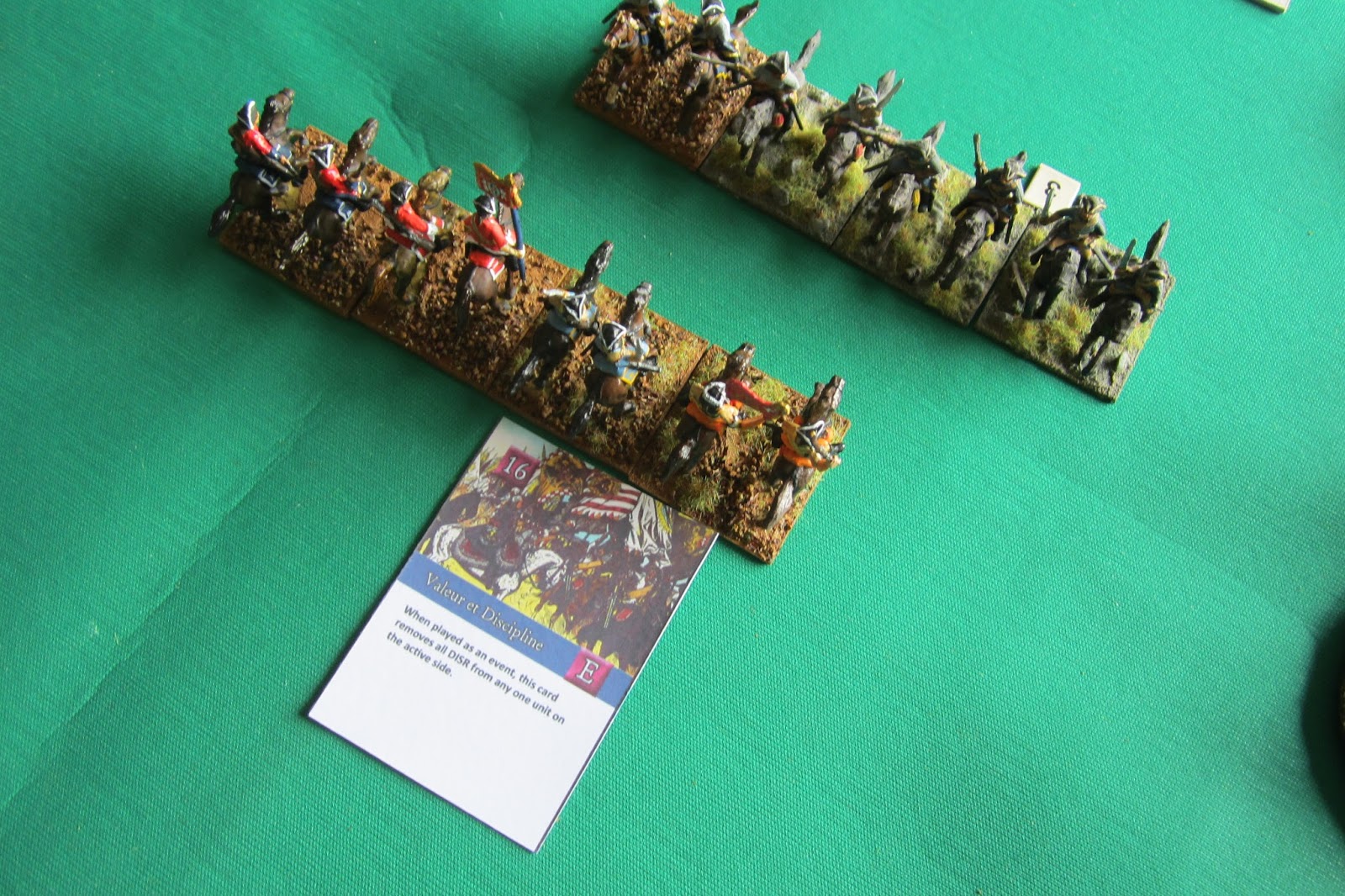
For a couple of moves the battle rages with 3 Disr for both; the Danish plays “Valeur and Discipline”, recovering all Disr and going to have the edge in the combat. At this point the Swedish advances two brigades of infantry for support. At the end the ensuing volley fase both cavalry are with 4 Disr, on the verge of being broken.


A second line brigade is put in column to support the advance: it will be a costly error, since it will remain stranded in the rear of the Swedish position till the end.


The Swedish in despair tries to rally its cavalry and succeeds: the Danish has no option left then to retire with a retrograde movement.


At this point the Swedish has two options: close to kill or pass: with few cards left, an activation at 12 BW would be costly and the Swedish decide to pass, takes 3 cards, and gives the Danish cavalry the possibility to recover.


(Notice in the picture the makeshift, less intrusive, Disr markers. The Disr value is that in contact with the unit)

At the end of this phase of the battle the Swedish is placed in a better position and can go ahead with the planned attack in echelon. The central part of the battle is going to develop.


Monday, September 19, 2016

Maurice playtest: part I


In the late 2013 I playtested Maurice Lite: no picture were taken since the camera was jammed at the time. Then in 2014 I bought the fully-flegded version of Maurice and after a more couple of years I decided to playtest it. I have painted enough Danish units to get a small army to oppose at a more or less equally small Swedish one.

The situation is that of the Scanian campaign, a small trained Danish army against a more numeros but less trained Swedish army (so this will not be Helsingors, rather an “Helsingors Lite”…). I kept the terrain as simple as possible (a wood and an hill with a stream at the “short” boundaries, two small hills behind the lines to mark the objectives.


The Danish army (in background) is composed by 2 Regular Cavalry, 3 Regular Infantry and 1 gun, all Trained. The national advantage is “Lethal Volley”. Total points 45.

The Swedish army (in the foreground) is composed by 2 Regular Cavalry, 1 Trained Regular Infantry, 4 Conscript Regular Infantry and 2 guns, Trained: the infantry is all pike-armed. The national advantage is “A là Baionette”. Total points 46.

The Army Morale should be 3 for the Danish and 4 for the Swedish: I fixed both Army Morale to 4 to avoid “sudden death” situations in the very first stages of the playtest.
The battle is a small one, so I can concentrate to understand the rules.

The Swedish plan is to attack with the left flank, which is covered by the wood: the cavalry must spearhead the advance of the trained unit (that with red facings: Narke-Varmalands and Jonkopings) and two further conscript units. The other two conscript are “refused” and protected by the cavalry. By using “A la Bàionette” the swedish hope to break the Danish morale and maybe conquest the objective.


The Danish plan is straightforward: wait for the Swedish advance and kill them piecewise with the “Lethal Volleys”.


The Danish centre with the artillery in front of the infantry units. From left-to-right Lollandske and Prins von Hesse brigade, 1st Danske and Prins Christian brigade and on the right Garden tip Fods and Grenadierkorpset brigade (I didn't make this brigade Elite in the playtest).


The Swedish centre: on the right the Narke-Varmaland and Jonkopings Trained brigade.


A close-up of the left-wing swedish cavalry with the two lines of infantry in background.


The view from the Swedish right-centre towards the Danish line.


Wednesday, September 14, 2016

Danish heavy cavalry at Helsinborg


There were six heavy cavalry Danish regiments at Helsinborg which I painted from the Strelets Reitars of Charles XII box. Their uniform was, before 1711, a grey-white coat with colored facings, only the Livgardet with a red coat and yellow facings. However their battledress was a buff coat (Kyller) with a black breastplate. I opted for such an outfit for all but the Livgardet which I represented in red.


Going into details the six regiments are:


1st Jyske Cavalry Regt: the oldest cuirassier regiment of the Danish army, in an uniform very old-fashioned with an helmet reminiscent of TYW. Indeed in 1699, they received royal permission to continue to wear a breastplate, which also covered the back as well as helmets and maybe even cover the arms and legs. Luckily enough the Strelets box has just two miniatures of this type (three if we count the an odd kettle-drummer)


Livgarden Til Hast Horse Regt: at Helsinborg, according to Snorrasson, the regiment was dressed in buff coat. However I like the red/yellow combination and I painted it accordingly. Also the flag is a later model, from 1720, the 1710 flag being white with some unknown design. 

1st Sjaelland Horse Regt.


1st Fynske Cavalry Regt.


2nd Fynske Cavalry Regt.

3rd Sjaellandske Cavalry Regt.

To complete the Danish Army at Helsinborg i have to paint three dragoons and  six infantry regiments, plus artillery and commanding officers.


Friday, September 9, 2016

Kolin: an update


Some time ago I started to post about the project Kolin, a case study of the battle simulation with three different set of rules, namely Volley and Bayonet, Maurice and Db-Hx, all of which have a nice scenario for such a paradigmatic battle.

At that time I missed a lot of hussars regiments to complete the V&B scenario. In these months I filled the gap and thanks to a new photo camera I am going to show you the results.


The 6 Austrian regiments still missing, which in details are, left to right: first line HR 41, Warasdiner, HR 17, Kalnoky, HR 36, Palatinal, second line HR 35, Morocz, HR 34, Desseffwy, HR 11, Nadasty).


The Prussians: 


HR 3, Warnery, HR 4, Puttkammer and  HR7, Malachowsky, (left-to-right)


on the right the HR 8 Gersdorff (the Maxen Red Hussars) and the HR 5 Ruesch (Totenkopf), whereas on the left two cuirassiers regiments which I didn't paint yet because they weren't at Torgau, the CR 9 Bredow and the CR 6 Baron von Schoinach (both of the Maxen lot, too)

Monday, September 5, 2016

Danish Infantry at Helsinborg. Part I


Here the first half of the Danish Infantry at Helsinborg:


Prins Christian Regiment: as far as the flags are concerned, I opted to paint them instead of removing the original flag and use printed flags. Maybe the result is not the best but I enjoyed a lot to paint the flags.


1st Danska Regiment: one of the four regiments loaned to the Maritime Powers and called back in 1709 for the incoming Scania campaign. According to Hoglund, Salnass and Bespalov, after the Italian campaign of 1703 the Danish regiments were reorganized into three. This one was formed with a battalion of Prins Georg and companies of Drottingen and Marine regiments.


Viborg och Lollands Landmilis Battalion. A Land battalion raised in 1701 and disbanded in 1717.


Prinz von Hesse Regiment. I used a Games Workshop flesh to render the “Feuille Morte” facings, instead of a plain orange. I liked the result.


Grenaderkorps Regiment. The officer is from the Mars “Swedish Infantry”.


Garden Till Fods Regiment: here I used a Grenadier from the Mars “Swedish Infantry”. In the next group of regiments I’ll put some grenadiers to add colors and variety. According to Dan Schorr the officers were fully dressed in red.


At the beginning I planned to made the colored-coat regiments with some Zvedza: however I found that the Mars have a strong “personality”. As the review in PSR points out, they are not the best figures on the market and are on the verge of uglyness: however I find that they look pretty “Baroque”, so I’ll finish all the Danish infantry with Mars figures. 

Thursday, April 21, 2016

Great Northern War. Danish army


My interests in the Great Northern War were recently revamped. I took from my library the boardgames “Peter the Great” (3W) on the battle of Poltava (with the additional Lesnaja scenario) and “On to Moscow” (SPI) on the whole russian campaign of Charles XII. 


As you can see from the older posts, I have a Swedish and a Russian armies in 1/72 plastic, mostly Strelets, Zvedza and some Mars.

I decided to add a Danish army to the lot. The Danish army is an interesting one, since from the peace of Travendal (1700) to the aftermath of Poltava it was absent from this war: however whole regiments were lent as mercenary units to Austria and the Maritime Powers in their war against Louis XIV and so Danish units can be used in a Blenheim refight. Moreover the infantry with their grey-white coats with multicolored cuffs, collars, trousers, gaiters and waistcoat they are a nice contrast with the swedish and the russian (and to add variety there are some regiments in red, blue and pale yellow). The cavalry used buff coats (it seems that Denmark was one of the last country to use this garment) with cuirass (one regiment also with helmet in a true Baroque fashion). So it is a very nice addition to any collection.

The informations on the uniforms can be found on the sites Tacitus and Northern Wars, as well as on the second volume of the Lars Hoglund book on the Great Norther Wars uniform which I used to obtain informations on the Russian uniforms.

As in the case of the other two armies, rather than to paint units at random I select a battle, in this case the Battle of Helsinborg (1710), a nice V&B scenario for which is given here by the Wyre Forest Wargame. Once again every regiment is depicted in two 40mmx20mm bases in such a way that 2 bases can represent a V&B linear base regiment (full scale) or each base can represent a battalion (battalion scale) at half-scale. The nicety of such a choice is that both in the regimental full scale and in the battalion half-scale, the terrain scale is the same. In the battalion scale the time scale is 1/2 hour instead of 1 hour and of course there is more detail. By the way the scenario provided by the WFG admits both the options (regimental and battalion scale).

Going to the miniatures, I have a box of the Mars Saxon Army which I used for the Russian commanders. I like these miniatures because they have a lot of details and a strong “personality” so I decided to use them for the bulk of grey-with clad Danish regiments, using some Strelets somewhere. For the red and pale-yellow clad regiments I instead plan to use the Zvedza Russian Infantry (really I have not yet decided..). The cuirassiers regiments will be done by using the Strelets Swedish & Drabant cavalry (which have some models with cuirass and helmet nonetheless) whereas for the dragoon regiments the Zvedza Swedish dragoon box seems to be appropriate.

By using three miniatures for each base with the contents of the box I can model three regiments (6 bases) plus the grenadier regiment (2 bases).

So, I am going to clean and prime them, it will be a long and interesting project….


Sunday, April 10, 2016

Korbitz, Part V. Hadik vs. Finck


After many months I finally get the time to finish the Korbitz refight. My camera still jammed I decided to took pictures with PhotoBoot: of course they aren’t the best possible but still help to understand the course of the action. 

I decided to represent all the battlefield north of the Triebitsch so both Lamberg and Brentano are deployed from the start.

The initial situation is the following:


seen here from the Prussian


and the Austrian perspective:


The whole affair is different from that between Wunsch and Zweibrucken: here the Austrian have a clear-cut superiority but they have only three turns to obtain a result.

The Austrian plan is to fix the enemy infantry with the, and the cavalry with Schallemberg command whereas Brentano shall turn the Prussian right with his Croats opening the road for Lamberg: since it is impossible to exhaust all the Prussian division because Zweibrucken failed to do it, to prevent a Prussian victory the battle Hadik must inflict more losses to the Prussian. The “butcher bill” of the action between Wunsch and Zweibrucken was 16-5 for the Prussian.


This is the situation after the first turn:


the cavalry battle is still undecided whereas the Austrian center has disarrayed the Prussian infantry: the two Prussian grenadier units of the second line move towards the Croats.


After the second turn the battlefield looks like:


the Prussian cavalry is exhausted and Hadik decided to send Lamberg to the right to exploit the success, since Schallemberg is one SP close to exhaustion. In the center the Prussian lose a Grenadier unit and retreats.

In the final third turn the Austrian pushes the attack but the Prussian cavalry resists to the attack of both Schallemberg and Lamberg cavalry: in the center Hadik exhausts the Prussian infantry. The last Prussian move is a retreat toward Meissen. 


Hadik was able indeed to exhaust both the Prussian commands, the battle being better managed that the Zweibrucken one: however Brentano, Schallamberg and the Infantry center are 1SP close to the exhaustion. the total losses are 22-14 for the Prussian which wins the battle. Again a superior Austrian-Imperial force fails to annihilate a Prussian force. The failure however was more from the strategic point of view: indeed Zweibrucken arrived piecemeal on the battlefield and Hadik was able to engage battle too late. In this sense I feel that the scenario was a good simulation of the frustrating situation the Austrian have to deal with in Saxony in 1759.