Wednesday, June 8, 2011

Holowczyn Project: Russian Order of battle


First of all the only contemporary map of the battle I was able to find:


and another modern depiction of the battle, this time from a swedish website:


The actual russian troops which took part at the battle are difficult to estimate. Of the nearly 30.000 which stood in the area probably no more than between 11.000-18.000 where actually engaged. Indeed looking at the Nafziger OoB (708GAA) one founds an estimate of 7.500 soldiers for the Repnin command in 17 battalions, 10.000 horses in ten regiments for the Goltz cavalry together with nearly 4.000 cossacks (7500 in eight regiments and 1500 respectively according to the OoB given Konstam’s Osprey) and other 7.800 in 18 battalions from the Sheremetev command.
When one look at the regiments which actually took part in the battle, Nafziger, Konstam and the battle honours given in Hoglund’s book gives conflicting informations. The best agreement is on Repnin’s command. Indeed, despite Konstam gives two brigades under Schweden and Chambers (whereas Nafziger gives three sub units, one of which commanded directly by Repnin), both list the same regiments. Strangely enough Hoglund doesn’t credit Narvski and Prince Repnin Grenadiers as present.
The situation is more confused about Goltz command as appears from the following table:

Regiments
Nafziger
Konstam
Hoglund
Pskovski
X
X

Tverskoi
X
X

Belozerski
X
X
X
St. Peterburgski
X


Azovski
X

X
Riazanski
X


Astrakhanski
X


Troitski
X


Novgorodski
X


Nishegorodski
X


Vladimirski

X

Permski


X
Rostovski

X
X
Life Regiment


X
Tobolski

X
X
Smolenski

X

Viatski

X


The Sheremetev infantry units listed by Konstam (Pskovski, Astrakhanski and Ingermalandski) seems to refer to those effectively engaged, whereas Nafziger lists Wiede Grenadiers (cited also by Hoglund) in place of the latter.

Since I want only to play a wargame and not to obtain a PhD in Eastern European history, I decided that the best compromise was to take the OoB from the Englund game, which seems based mostly on Nafziger (whose numbers for the Goltz cavalry seem a bit exagerated) with the Vladimirski cavalry credited to Sheremetev. As far as the Cossacks are concerned, since they were held at bay by the Valackers, I decided to leave them out alltogether.

Accordingly, my V&B Order of Battle for the Russians reads:

Russians Army ( approx. 10.000 Inf.,  4.500 Cav., 8 8pdrs. Guns, 4 Howitzers)
Note: at the beginning of the game, and until Scheremetjev arrives on table, Repnin is the Russian army commander. Once Scheremetjev arrives on table he assumes army command and Repnin becomes a CC under him.

Repnin's Wing: General of Infantry Prince Repnin (CC)

Gen. Lieut. Von Chambers (DC)
Exhaustion=8
Koporieschski Regiment/I 2-4
Koporieschski Regiment/II 2-4
Tobolski Regiment/I 2-4
Tobolski Regiment/II 2-4
Narvski Regiment/I 2-4
Narvski Regiment/II 2-4
Narvski Regiment/III 2-4
Vjatski Regiment/I 3-4
Vjatski Regiment/II 3-4
Kogan's Artillery 2-5, fld

Gen. Maj. Von Schweden (DC)
Exhaustion=9
Rostovski Regiment/I 2-4
Rostovski Regiment/II 2-4
Lefort Regiment/I 2-4
Lefort Regiment/II 2-4
Ryazanski Regiment/I 2-4
Ryazanski Regiment/II 2-4
Prince Repnin's Grenadier Regt/I 3-5
Prince Repnin's Grenadier Regt/II 3-5
Repnin's Artillery 2-5, fld

Goltz wing: Gen. Field Marshal Lieutnant Von Der Goltz (CC)

Gen. Maj. Ifland(DC)
Exhaustion=3
Pskovski Dragoon Regiment 2-4 md
Tverskoy Dragoon Regiment 2-4 md
Belozerski Dragoon Regiment 2-4 md

Gen. Lieut. Heinske (DC)
Exhaustion=3
St Petersburgski Dragoon Regiment 2-4 md
Azovski Dragoon Regiment 2-4 md
Ryazanski Dragoon Regiment 2-4 md

Gen. Lieut. Von Hessen Darmstadt (DC)
Exhaustion=4
Astrakhanski Dragoon Regiment 2-4 md
Troitski Dragoon Regiment 2-4 md
Novgorodski Dragoon Regiment 2-4 md
Nishegorodski Dragoon Regiment 2-4 md

Scheremetjev Wing: General Scheremetjev (AC)

Renne (DC)
Exhaustion=3
Schere's Battery 2-5 fld
Vladimirski Dragoon Regiment 2-4, md
Ingermanlandski Regiment/I 2-4
Ingermanlandski Regiment/II 2-4

Gen. Maj. d'Albion (DC)
Exhaustion=4
Pskovski Regiment/I 3-4
Pskovski Regiment/II 2-4
Astrakhanski Regiment/I 2-4
Astrakhanski Regiment/II 2-4

Sunday, June 5, 2011

Holowczyn Project: the battle


We left the Swedish army on the left of the river Vabitj, at the hinge between two-thirds of the Russian army, about 30.000 troops in thirteen foot and eleven cavalry regiments under the General of Cavalry Aleksander Menshikov and General Field-Marshal Boris Sheremetev, ready to prevent a Swedish river crossing and the command of Prince Anikita Repnin, deployed a few miles south with nine infantry and three dismounted dragoon regiments under Ifland, with additional mounted troops under Major-General Franz Rüdiger von der Goltz further south. Repnin command was separated from the bulk of its cavalry in the south and moreover, he could not be easily helped from the north since a thick forest stood in the road.

Charles XII spent few days to reconnaitre the enemy position: then, on July 3 more Swedish troops arrived at the scene bringig his forces to a total of 10.000-11.500 soldiers. Now the King spread out, through false renegades, rumors that the Swedish army would force the river turning the enemy's right (north) wing: to give weight to these rumors the King sent a large corps of Valaker (Polish light cavalry) to the north backed by more cavalry under Field-Marshal Rehnskiöld had marched. The ruse worked well, since the Russians sent four battalions (about 2.000 men) to the place where the river crossing was expected.

As the attention was directed to the north nor Repnin neither Goltz took special protective measures, apart some hastily-made entrenchements. From a letter from Menshikov to Tsar Peter the Great it appears that Charles XII's stratagem was successful, the Russians waiting for an attack on their right wing to the north where Menshikov sent reinforcements whereas Repnin remained totally unaware of the swedish real intentions.

At midnight on July 4, the Swedes started to move quietly towards the river: infantry carried fascines to help them traverse the boggy ground before crossing the Vabitj on leather pontoon bridges. However, heavy rainfall made the pontoons too heavy to carry and they were left behind.
It was 3.30 a.m. when the Swedish artillery began shelling the Russian positions with a cannonade that would be ongoing for three hours. One of the first to fall beheaded by a Swedish shot was, ironically enough, Major-General Wilhelm von Schweden.
After an hour of firing the Karl XII decided that it would wade across the river even though the water reached up to chest height: he thought that one should "attack the enemy sooner, before he could consolidate more, and get rid of the rest of the hostile army reinforcements". He put himself in front of the Lifvgardet Grenadier Battalion and after forming with difficulty on the boggy far bank, his command began to advance through the marsh. Meanwhile, fascines were laid on the river banks to assist the cavalry's crossing.
Now, both the engineers and the Guards began to be targeted by Repnin's artillery which was firing both cannon balls and canister. The troops stood bravely under the fire despite heavy losses until more battalions crossed the river and alltogether advanced against the enemy entrenchements.
Repnin soon saw the danger of a Swedish wedge forming between the two Russian positions, and ordered his men to decamp and head north toward Sheremetev, which, despite being alarmed by reports about the Swedish attack, was convinced that it was a feint. ( The following maps, found for free on the web, were from the Peter From book “Katastrofen vid Poltava”, Historiska Media 2007 )


The Russian front was rapidly disintegrating: however the Russians, in order to screen their retreat turned a few guns against the marsh where a large number of swedish soldiers were marching forward: the effect of gun fire was devastating. Finally the Russian infantry dissolved in panic eastwards and southwards: some Russian battalions were cut down to the last man, despite pleas for mercy, by the advancing Swedes. The King recalled his troops with some difficulty, and instead of advancing north towards Sheremetev army, he turned his attention to the south, from where Goltz cavalry was arriving.


Part of the swedish cavalry under Rehnskiöld arrived on the scene just in time to engage a fierce battles against Goltz squadrons. The Russian Major-General had ordered his cavalry on the swedish flank in an attempt to decide the battle: however the Livregiment charge decided the battle and the Russians vacated the field with heavy losses. All the Russian cavalry which was south of Repnin positions was routed, three from the ten regiments in the Goltz command were virtually destroyed as well as the great part of the irregular cavalry. When Karl XII arrived to support Rehnskiöld with the Småland, Östergötland and Nylands cavalry regiments the fighting was almost already over and the swedish cavalry joined in the pursuit of the fleeing remnants of the Russian cavalry. The full extent of the Swedish victory in the battle against Goltz third cavalry group under von Hessen-Darmstadt was told by the hundreds of Russian corpses and horse carcasses lining their path of retreat.

Sheremetev, after the fourth report from Repnin, finally took the initiative to attack the almost undefended Swedish camp to the west and began to send troops to the south, three infantry and one dragoon regiments. However, these troops were easily repulsed and when the news of Repnin setback reached him, he decided not to wait for a Swedish attack on his rear, but instead began to retreat towards the Dnieper: indeed the King was turning all his forces against the Sheremetev troops opposite Holowczyn. With the retreat of the Russian main body the battle was effectively over.
There are no reliable figures on the number of dead and wounded in the battle of Holowzcyn, but the Swedish data are talking about around 260 dead and a little more than 1.000 wounded in their ranks. The Foot Guards, the Livgardet horse and the  Livdragoner had the biggest losses, totaling for over 70% of the total number of dead and wounded. This was because these units fought in the first line with the King and Rehnskiöld, a loss of elite troops which was difficult to affar. The Russian had, according to some Swedish sources, over 5.000 men dead, wounded or missing, whereas other sources speak of 1.662 dead, wounded or 
missing and 701 dead and wounded horses. It seems that a figure between 2.000 and 3.000 killed and wounded would appears reasonable.
The battle of Holowczyn was Karl XII favorite victory: indeed despite difficult natural obstacles and superior enemy artillery, the Swedes were able to achieve surprise and defeat the numerically superior Russian forces.

Saturday, June 4, 2011

Holowczyn Project: Swedish Infantry


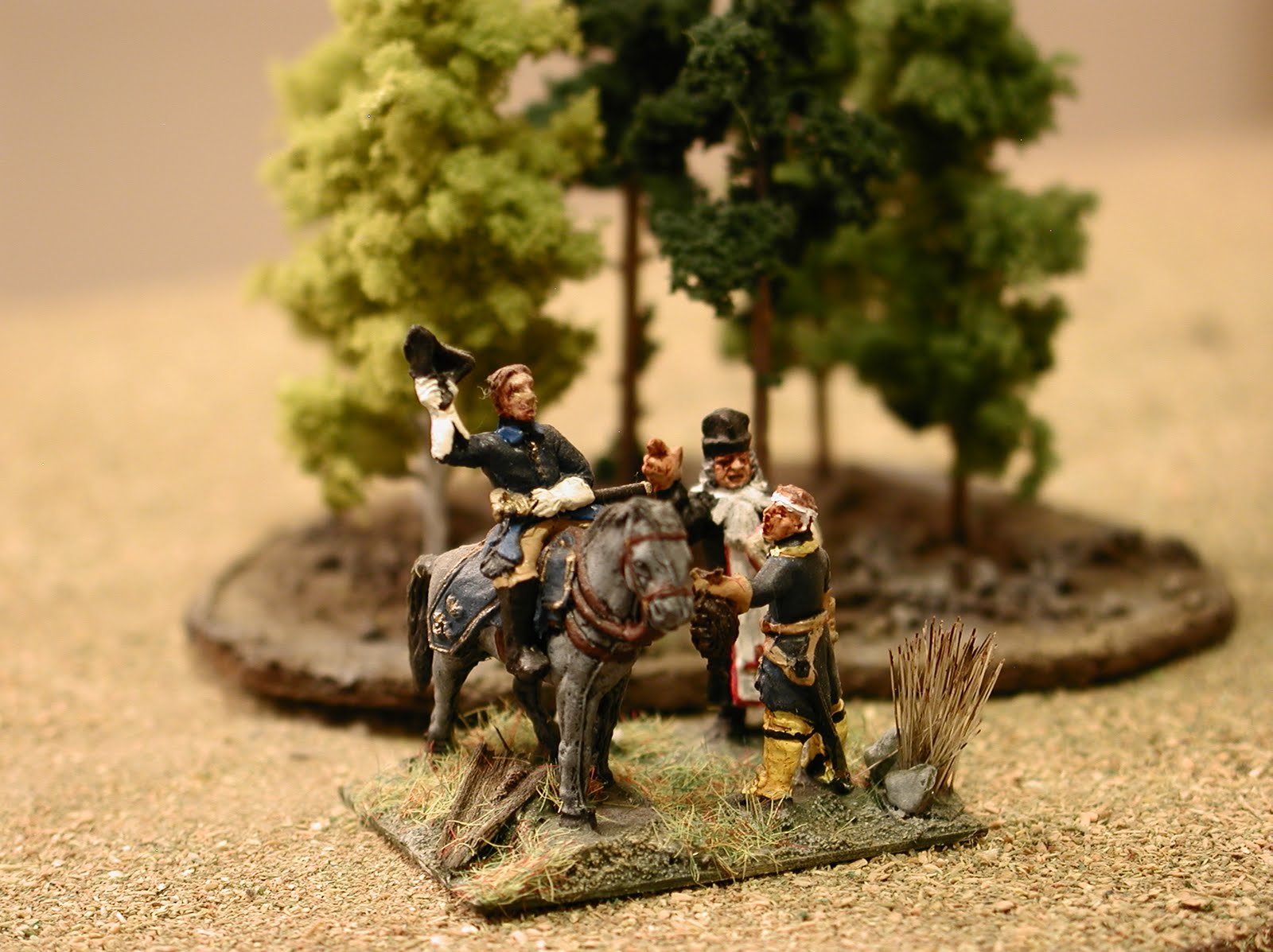
The first assault wave was under the direct command of Karl XII, here assisted by a priest while conferring with a wounded officier (all figures Strelets)


and was comprised of the four Guards battalions 


and the second battalion of the Dalcarian Regiment (Col. ) in karpus:


All the Guards battalions have the same uniform and in order to identify them I gave the flag to the Livgardet battalion, whereas the Grenadier battalion (with tricorne) is the one with the drummer. The Guards are Zvedza.

These troops forded the Vabijti river with the water almost chest height, after one hour of prolonged firing by the swedish batteries (the heavy gun is represented with four gunners, one field battery still missing in my OoB):


The second infantry wave was under the command of Maj. Gen. Sparre, whose command figure is still on the painting desk together with Creutz and the second field gun...


and was comprised of the first battalion of Dalcarian together with the Vastamaland:


Uppland:


and Ostgota regiments: